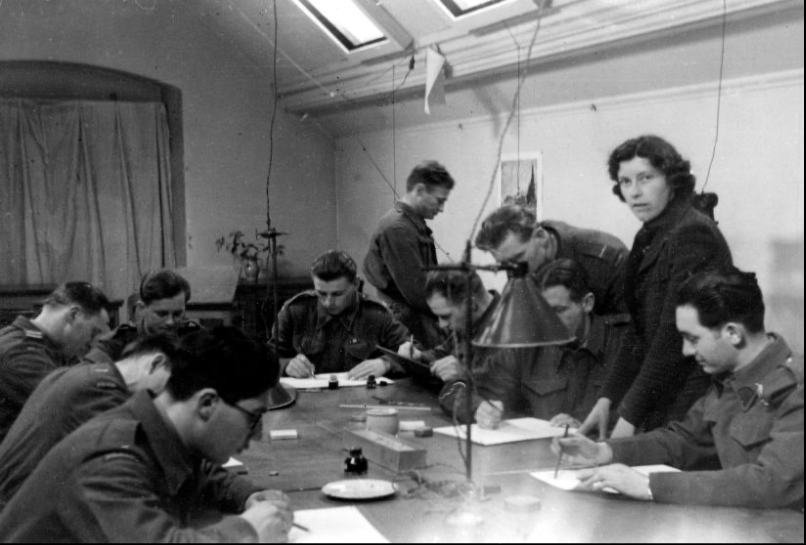
Soldiers-students at the University of St Andrews engaged in a wide range of activities beyond their academic pursuits. For example, archive footage in the University’s collections shows art classes, supported by the Committee for Education for the Forces, where soldiers learnt to create woodcuts and woodcut prints:

The woodcuts they produced include depictions of daily life, sport, religion, portraits, still life, and more topical themes such as war and work. There are clear references to ‘home’ – specifically the woodcut of the wooden house below left, which is likely Willa pod Jedlami in Zakopane, recently featured in the Young Poland exhibition at the William Morris Gallery, London. The image on the right appears to be of a church, but whether in Poland or Scotland is not clear.


Right: woodcut, church or other building. Image courtesy of University of St Andrews Libraries and Museums, item ms38341.
The two woodcuts below show very contrasting scenes. On the left is a devastating portrait of war (signed ‘Paprotny 41’); on the right, a depiction of a football match in Brighton (Mecz piłkarski w Brighton, signed ‘Mirecki Władysław’). These two artworks capture the dual reality that many forced migrants live, between traumatic memories of conflict and everyday pockets of peace. This is something that Mat Fahrenholz discusses in this podcast reflecting on his parents’ experiences of post-war life as Polish exiles in St Andrews. A similar duality can be seen in artwork from different periods and places, such as the exhibition Of Ordinary Things hosted in Oxford in 2021 by the Iraqi Women, Art and War Group.
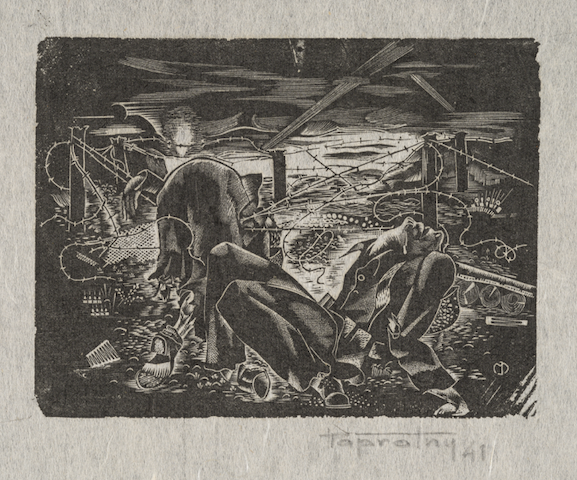
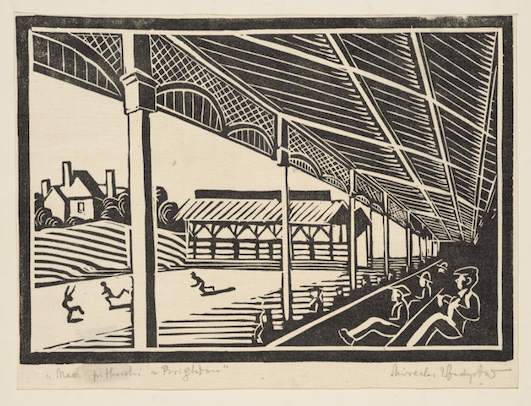
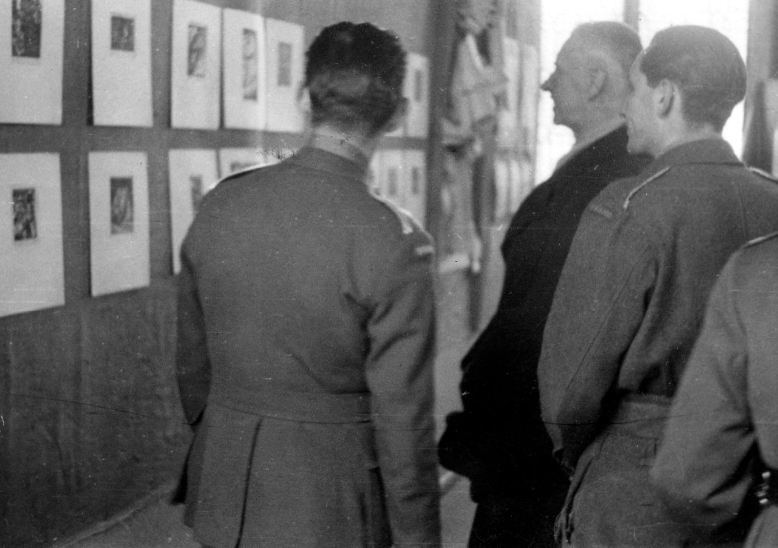
The technical skill of these woodcuts and woodcut prints is very high, and their storytelling power – both individually and collectively – is impressive. They may have been the products of occasional art classes, designed to occupy and educate Polish forces stationed in Fife; but together they help us picture the kinds of ideas and images that occupied their authors’ minds, as they looked back to their past lives in Poland and captured their present day in Britain. Some of these woodcuts were exhibited in 1944 in the National Gallery of Edinburgh.

We chose to feature these woodcuts because they connect to Diana Forster’s art in some ways. Do you see any similarities in style? What impact do their representations of home and conflict have on you as a viewer? How can art be an outlet for processing elements of displacement?
For more information about the woodcutting lessons in St Andrews during the Second World War, see: https://app.dundee.ac.uk/museum/exhibitions/djcad/wood/index.html.