By necessity, forced migrants must familiarise themselves with other cultures and learn new languages, as they cross borders and put down roots in countries far from home. Knowledge exchange can flow in both directions, however, with local people in turn learning something about the places where their new neighbours have come from.
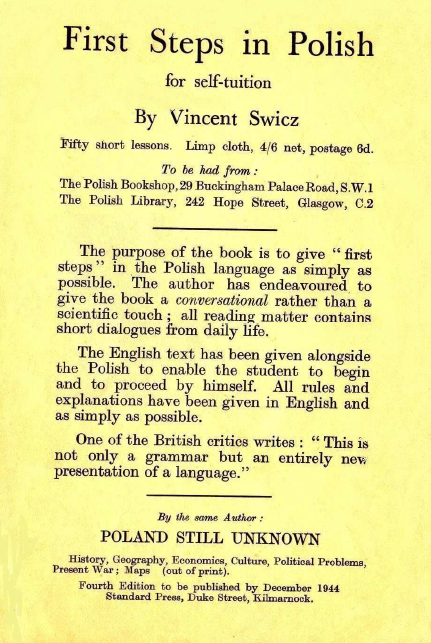
With the arrival of many Polish migrants to Britain during the 1940s, Polish culture and customs were gradually shared with the local population, and the demand increased for English-speakers to learn the Polish language. According to a 1944 letter from the Director of the British Division for the Polish Ministry of Information, there were nearly 2,000 British women married to Polish soldiers in the final year of the Second World War.
The image on the right is an advert for a manual called First Steps in Polish, one of the first books of its kind to offer self-taught Polish language learning for English-speakers. In addition to British citizens married to Polish individuals, the manual was targeted at those who were engaged in Polish societies or those interested in moving to and working in Poland after the war. As the description suggests, it was designed to be as accessible as possible, innovating with its teaching style to appeal to a wide audience and make learning Polish feel ‘simple’, not arduous.
The manual’s Polish author, Vincent Swicz (born Wincenty Szczęsnowicz) was a captain in the Polish Army who lived in Kirkcaldy for some years during the war. According to his nephew, Professor Tadeusz Trzaskalik (University of Economics in Katowice, Poland), he ended up spending around half his life in Scotland, before moving to Whitby, where he founded a Polish-British correspondence club and published multiple books about Poland in English. The poster included here advertises his other work and the content of First Steps in Polish, which included fifty lessons and Polish text alongside its English translation.
As you can see from the images below, Swicz gave regular lectures based on the contents of his books. He was deeply committed to knowledge exchange between Polish and British communities. As well as his military rank and service, the posters mention his affiliation to the ‘Ministry of Information’, and make it clear that some of these talks raised funds for Polish societies. They paint a picture of a well-supported, systematic effort to deepen British understanding of Polish history and culture.
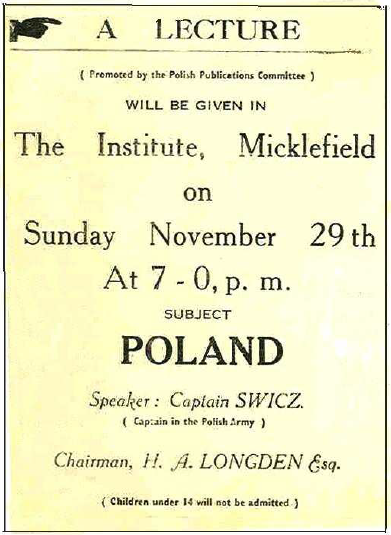

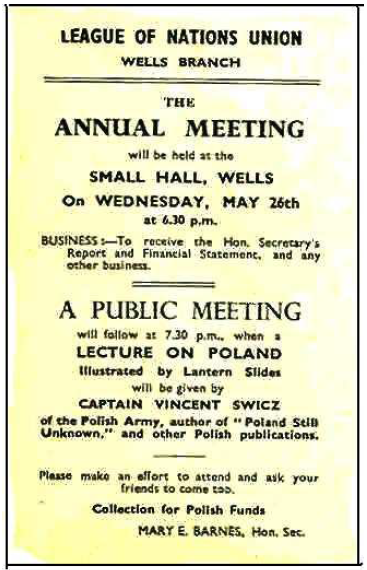
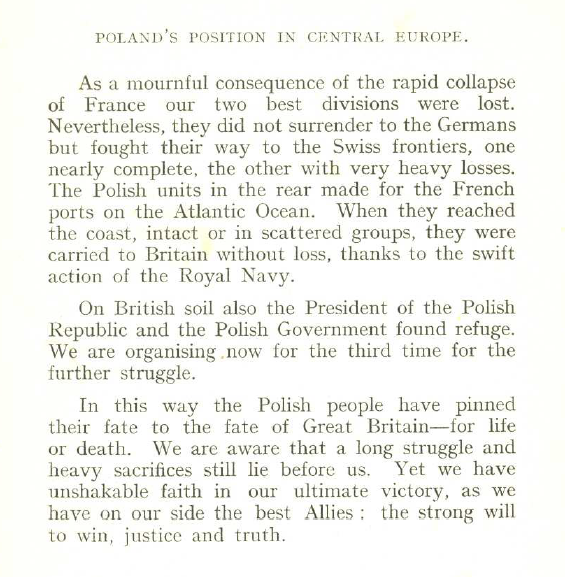
While we do not know exactly what Swicz talked about in these lectures, we are lucky enough to have several publications that can give us a fair idea. In particular, his pamphlet Poland’s Position in Central Europe (Standard Printing Works, Kilmarnock: 1941) seems to be the text of a lecture he gave at Glasgow University, at the invitation of the Historical Association of Scotland (West of Scotland branch). Thirty-six pages long, it includes: ‘Some words about history’; notes on Poland’s geographical position and population; economic information; pointers about Polish agriculture and industry; ‘Poland’s position between Russia and Germany’; ‘Relations with other neighbouring countries’; ‘Poland and the Western Powers’; some reflections on Germany’s invasion in 1939; and a final chapter entitled ‘We believe in Victory’. In other words, it combines some general background information with focused analysis of contemporary events from a Polish perspective. In fact, the text clearly aims to address gaps in understanding and misconceptions held by people who are not familiar enough with Poland’s history, as a contribution to Polish-British relations and the wider war effort. In particular, it dismantles a series of Western misunderstandings of Poland’s needs and vulnerabilities from the end of the First World War onwards, critiquing Western treatment of Poland and championing Polish loyalty, political strategy and resistance to the Germans against the odds. In his foreword to the pamphlet, Swicz anticipates some objections to his forthright analysis – but he remains determined to share it nonetheless, arguing that this is the better foundation for mutual understanding than an account that is merely flattering to the British. In his conclusion he expresses gratitude to Britain for providing Polish people with multiple forms of support and refuge, celebrates their relationship as allies, and looks ahead to the struggles still to come, as the war continues:

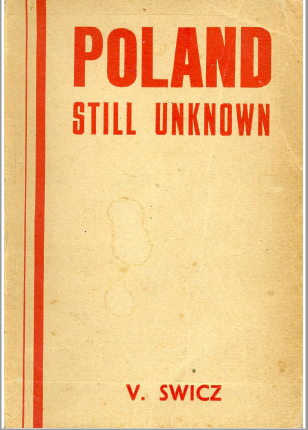
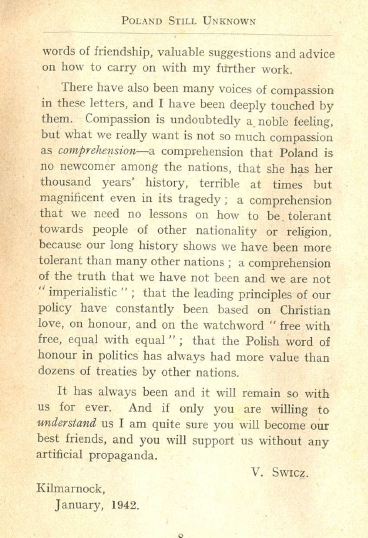
In another book, called Poland Still Unknown (Standard Printing Works, Kilmarnock, 1942), Swicz makes it clear that, while ‘knowledge of Poland is much more extensive than it was at the outbreak of war, yet it cannot be denied that the general public is still uncertain on many points.’ As well gaps in understanding, he blames enemy propaganda for the misconceptions about Poles and Poland that many British people still have. And he mentions the reception that his previous writing has had: not everyone has agreed with it, but he has had over 500 letters offering friendship and compassion as well as criticism and advice. He takes care to distinguish between compassion and comprehension, preferring the latter. He is passionate in his desire that Polish history, politics and identity be better comprehended, arguing: ‘if only you are willing to understand us I am quite sure you will become our best friends, and you will support us without any artificial propaganda.’ The stakes are high in Swicz’s efforts at knowledge exchange, he implies, because misunderstanding between Polish and British people has serious consequences, not just for individuals but for the wider war effort.

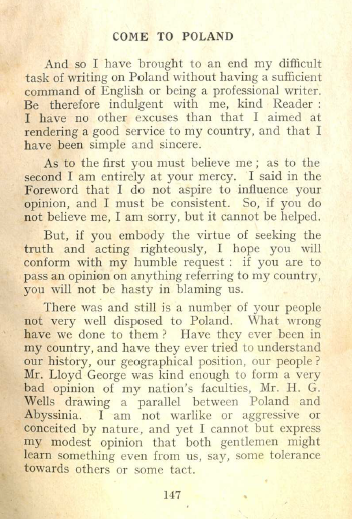
Like his pamphlet Poland’s Position in Central Europe, this book covers topics such as Poland’s geographical position, Polish political history, information about population, government and infrastructure, and notes on Polish economics and culture. It also ges deep into Poland’s relationships with Germany, Russia and Western allies, and reflects on events from 1914-1942. These two pages offer a sample of the information it shares:


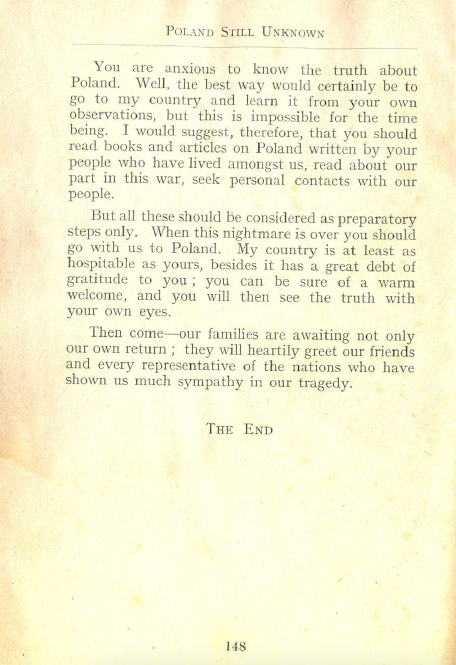
Swicz ends by returning to his concern that some people in Britain still do not understand – and indeed are not favourably disposed towards – Polish people. His recurrent anxiety about this does not simply stem from the specific historical circumstances of the Second World War; they speak to a perennial challenge faced by all forced migrants – that ignorance, propaganda and prejudice can harm relations. His closing words are more affirmative, however. Books offer knowledge, talks are an opportunity for dialogue, and visits with Polish people – and ultimately to Poland itself – can round out the picture still further. Friendship and first-hand knowledge of people and places are the best way to counter ignorance and prejudice. ‘Then come – our families are awaiting not only our own return; they will heartily greet our friends and every representative of the nations who have shown us much sympathy in our tragedy.’ There is a lesson for all of us in Swicz’s words: conversation can lead to comprehension, and that can forge enduring, mutually beneficial friendships between forced migrants and the people who give them refuge.
We are indebted to Professor Tadeusz Trzaskalik for generously sharing his memories of his uncle Vincent Swicz with us, and for sending us such interesting materials to share on this site.
This 1942 film clip, from Imperial War Museum’s collections (IWM CPD 105), evokes some of the ideas that can be seen in Swicz’s works, in particular the feeling that British and Polish people will ‘never be strangers again’ (timestamp 4.00-7.00).