Each time forced migrants cross another border, there are new challenges to wrestle with. Another language; different rules and regulations; new support systems to learn. Paying for food and shelter is a perennial challenge, not least because finding (and being granted the right to) work can prove very difficult. And even once you have secured some kind of income, there are still plenty of hurdles to navigate. For example, how to set up a bank account, so that you can function financially and even start saving – albeit for a very different kind of future from the one you might have been planning before displacement?

As the numbers of Polish people in Britain increased over the 1940s, British banks and financial institutions began advertising in Polish to this new community of potential customers. The poster shown here was printed in Britain by the Post Office Savings Bank in London, on commission by the Polish Forces Savings Committee. It is an indication of the scale of this mass displacement that two national organisations collaborated like this to provide services for the Polish exile community.
The Polish text reads, ‘The time of return is near…what have you saved so far?’ It is advertising the value of saving now in order to support future plans. It seems to have been particularly aimed at soldiers who were hoping to return to Poland after the war, but it might have appealed to a wider group of forced migrants who were also trying to invest for the future. The clock and calendar imagery reminds us how many years had already passed since displacement; but the calendar layout (with a large red question mark next to a blank page for 1944) throws all the emphasis onto the future; and the clock hands are set at just before 12 o’clock, suggesting that time is ticking up to some kind of watershed moment. While drumming up new customers, this poster captures (and capitalises on) one aspect of displacement: the mix of uncertainty, anxiety and hope that many displaced Poles must have felt as they took steps to regain control over their destiny after arriving in Britain. Implicit in that red question mark are two fundamental questions that pursue all forced migrants, wherever they are on their journey: ‘What next?’ and ‘Do I have enough to support myself and my family through it?’
Of course, many Polish people who began earning and saving after arriving in Britain did not return to Poland, some out of choice, others because they had no homes to return to. As Mat Fahrenholz explains in this podcast interview, his parents’ homes had been in eastern Poland, which remained under Russian control after the end of the war. They were unable to go back, so they settled for good in St Andrews, Fife, along with many other displaced Poles. Mat’s father became a cobbler and ran a popular leather shop in the heart of the town. Together with the nearby Polish barber shop, it became an important community hub where members of the Polish exile community gathered to talk, share their common experiences, support each other, and enjoy each other’s company.
Such places had sprung up during the war itself, since many Polish servicemen were stationed near St Andrews. For example, Number 60 South Street became a Polish servicemen’s canteen. These images, from around 1940-1945, show the inside and outside of the canteen as it would have looked during the Second World War. Inside, you can see signs listing the available food for sale in both English and Polish; and the signs outside make it clear that soldiers could go there to relax, read and write, not just to buy food. This is another example of British society adapting to the presence of significant numbers of displaced Poles, by providing multi-lingual services and spaces. While the opening of Polish canteens and British bank accounts were relatively small steps in much longer journeys of migration and home-building, they remind us of the different forms that hospitality and home-making can take – and the impact that they can have. Being able to order a sandwich in your native language, or having access to a savings account in your adopted country: these little things can make a huge difference, breaking down barriers and opening new doors.
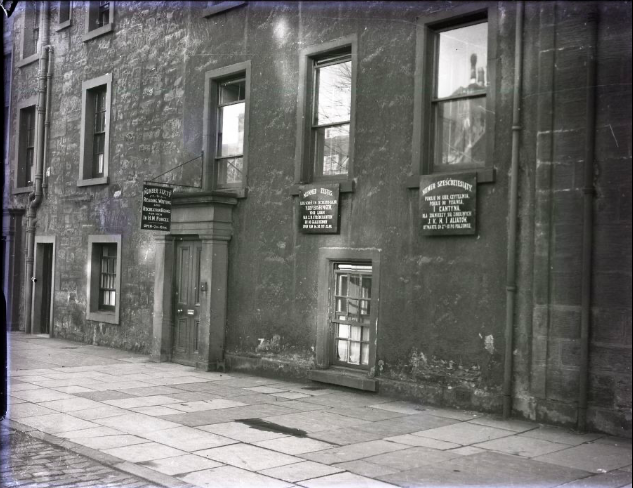

Right: The Polish Canteen, 60 South Street, St Andrews: shop counter covered with trays of buns (1940-45). Credit: George Cowie. Image courtesy of University of St Andrews Libraries and Museums, item GMC-32-14-3.
You can see more images of the presence of Polish soldiers and civilians in St Andrews during the Second World War in the articles below. The University of St Andrews and OnFife both hold fascinating items in their collections that testify to the experiences of Polish exiles in St Andrews both during and after the war. Imperial War Museum’s Collections also contain footage, including this 1942 film clip (IWM CPD 105), which shows Polish soldiers marching to bagpipes, helping bring in the harvest, folk dancing, and Polish language signs in shops (among other forms of interchange), probably in Scotland in 1942 (timestamp 4.00-7.00).
- The story of the the Poles came to play an important role in town life
- General Sikorski in St Andrews?
- General Sikorski
- Cracking Enigma
- Scotland’s Polish Parachute Brigade
- Poland-Scotland bond