What are children taught about forced migration as they grow up? Which media influence them? And what kinds of stories and images shape their understanding? Just as importantly: what do children themselves think? How do they understand or imagine the experience of being displaced or becoming a refugee? And what impact can their voices have on how we all visualise, talk about and address forced migration, locally, nationally and globally?
Diana Forster’s art installation ‘Somewhere to Stay’ provides a valuable opportunity to engage young people in inclusive, reflective conversations on this complex topic – and to hear what they have to say. Our approach is informed by our wider research into children’s voices on war and peace, and we are working closely with the educational charity Never Such Innocence to run schools workshops and give children opportunities to create art, poetry, speeches and songs that reflect what they have learnt and what they want to communicate.
All around the world, young people’s childhoods are saturated in imagery, narratives and experiences of war and its aftermath. By 2019, 1.6 billion children were living in a country affected by conflict (that is 69% of children globally). As well as direct violence, they suffer follow-on impacts such as famine, sexual abuse, disruption to education and displacement. Meanwhile, children living far from battlefields absorb stories of war and its many legacies via popular culture, museums, news and educational resources; stories curated largely by adults, which condition how they engage with conflict and its aftermath as they mature. Despite the multiple ways in which children are exposed to conflict from a young age, they are usually not seen as worth including in discussions of war’s impact or prevention.
This is largely true of discussions of forced displacement too; despite many children becoming forced migrants themselves, it is often assumed that only adults are ‘expert’ enough to comment authoritatively on it or make meaningful contributions to policy-making. The inclusive, child-oriented journalism of publications like First News represents an encouraging counter-example, for instance here and here. For some powerful child-centred storytelling on the topic of forced displacement, we strongly recommend Dina Nayeri’s book The Waiting Place, which is the basis of a successful school outreach project. UNICEF’s Unfairy Tales use animation to narrate three true stories of child refugees.
As with our wider work on war and peace, we are keen to explore a range of empowering mechanisms – all involving different kinds of storytelling, in a range of different media – that understand children as children but also recognise and centre their expertise on this challenging topic. Working with Diana Forster’s new artwork Somewhere to Stay, we encourage learning about different histories of forced migration, while helping the young people we engage with to develop awareness of their agency in shaping how we all visualise and address forced migration in future.
You can find out more about our schools workshops here, and we will share a range of young people’s reflections on forced migration as our project develops.

Wishing for Home
This poem was written by a Nataliia U. in September 2025, in response to Diana Forster’s art exhibition Somewhere to Stay, during a workshop at The Dick Institute, Kilmarnock, delivered by Never Such Innocence. War’s shadows have fallen down The crime of being Ukrainian getting punished. War has taken a loving home from us The terrors are… Read More
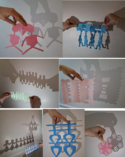
Picturing Home
During our exhibition of Diana Forster’s art work Somewhere to Stay at The Dick Institute, Kilmarnock, we collaborated with Never Such Innocence to deliver some workshops for local high school students and people with lived experience of forced displacement. Inspired by Forster’s use of the Polish craft of paper cutting (wycinanki), they created some art… Read More
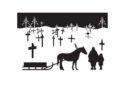
Shadow of the past
This poem was written by a high school student at Callendar House in September 2025, during a workshop delivered by Never Such Innocence, in response to Diana Forster’s art exhibition Somewhere to Stay. The days of work were always short In comparison to what I knew. When my coworkers complained of aches at the water fountain They were met… Read More

The people and me
This poem was written by a high school student at Callendar House in September 2025, during a workshop delivered by Never Such Innocence, in response to Diana Forster’s art exhibition Somewhere to Stay. James lived down the road from me Ever since we were ten We’d ride our bikes and climb up trees Go sliding round the bend. —–… Read More
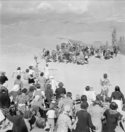
Strong art shows a strong heart!
This poem was written by a high school student at Callendar House in September 2025, during a workshop delivered by Never Such Innocence, in response to Diana Forster’s art exhibition Somewhere to Stay. It’s not running Though some may say it is Running requires choice Running is not being told Running is not being led Running is not being… Read More

Thatched Rooves
This poem was written by a high school student at Callendar House in September 2025, during a workshop delivered by Never Such Innocence, in response to Diana Forster’s art exhibition Somewhere to Stay. Thatched hooves are a lot better than I thought. The damp doesn’t reach me here You know If I close my eyes Then for one brief… Read More

Victim or Villain?
This poem was written by a high school student at Callendar House in September 2025, during a workshop delivered by Never Such Innocence, in response to Diana Forster’s art exhibition Somewhere to Stay. Victim or villain? Displaced from your home With nowhere to go And nobody to know. —– Victim or Villain? Expected perfection Through this redirection Persecution and… Read More

‘Leaving Anna’s Sister Behind’
This poem was written by a high school student at Callendar House in September 2025, during a workshop delivered by Never Such Innocence, in response to Diana Forster’s art exhibition Somewhere to Stay. She’s frail, she’s weak, and I can hardly look at her. She’s flesh and bones, not a stranger. They say she can’t come, She’s too… Read More

‘Why?’ by Jack D.
This poem was written at Callendar House in September 2025, during a workshop delivered by Never Such Innocence, in response to Diana Forster’s art exhibition Somewhere to Stay. Why? Why are they laughing, not paying attention, disregarding all I mention? I try to be vulnerable, open their eyes, but they’re too oblivious, caught up in their own lives?… Read More
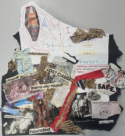
Collages depicting Forced Migration
These collages were created by two groups of school students at Callendar House in September 2025, during a workshop delivered by Never Such Innocence, in response to Diana Forster’s art exhibition Somewhere to Stay. They engage with the themes of displacement, rupture, violence and hostility, and they echo some of Forster’s artistic techniques. Diana Forster, Somewhere to Stay Read More

Collage by Millie J.
This collage was created at Callendar House in September 2025, during a workshop delivered by Never Such Innocence, in response to Diana Forster’s art exhibition Somewhere to Stay. Below, the artist Millie J. (Larbert High School) explains her vision. Millie J., Larbert High School This collage depicts the separation of families. The tree symbolises family; the separated graves symbolise separation.… Read More

Collage by Heather P.
This collage was created at Callendar House in September 2025, during a workshop delivered by Never Such Innocence, in response to Diana Forster’s art exhibition Somewhere to Stay. Below, the artist Heather P. (Larbert High School) explains her vision. Heather P., Larbert High School After seeing the art created by Diana Forster I was inspired by her ‘Cabbage Patch’ artwork.… Read More

Collage by Ella D.
This collage was created at Callendar House in September 2025, during a workshop delivered by Never Such Innocence, in response to Diana Forster’s art exhibition Somewhere to Stay. Below, the artist EllaD. (Larbert High School) explains her vision. Ella D. Larbert High School In response to the “Somewhere to Stay” exhibition I created a collaged… Read More
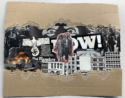
Collage by Alicia A.
This collage was created at Callendar House, during a workshop delivered by Never Such Innocence, in response to Diana Forster’s art exhibition Somewhere to Stay. Below, the artist Alicia A. (Larbert High School) explains her vision. Alicia A., Larbert High School This Collage looks to specifically depict the abrupt disruption forced migration has on someone’s… Read More

Raw Old Scars
I have witnessed the worldIn all its twisted forms.I find that now,After a lifetime,The cold makes me sweat. Icy, unlit trains slapMy face when I touchCold metal. And sweat drips heavy on my nose – Once small. I often wonder whyI was forced to crawl,Back spiked by foreign fencesTo nibble like a rabbit on tasteless leaves. And, in honesty,I wonder… Read More

Barbed
Barbed brick holds up the sky,About as inviting as a rat.Grey and hard, it lacks a rat’s Softness and yet, we placedA welcome mat over the threshold. Each day we were trooped into the clusteredFirs and pines, stalwart and cold,Indignantly spitting bark in our facesAs we wrestled them to the ground. We called this our job,And… Read More

Listen, because I’m begging you to
Throughout history, we have always had some conquest in mind. Nation building, Russification, Sinicization Manifest Destiny, Colonialism: God gave me this land. We can sit and deliberate on left or right, west or east, us or them. But they are us, we are them we fight for separate similar goals. I hate them. Their always harming, always self-victimizing, taking, stealing, pillaging. They need to be stopped. It makes me want to join It makes me want to… Read More

It was then, could be now
It was then, could be now, the people were taken, put on set tracks hurtling towards an abyss. First came the camps. That old Russian tradition, much more macro than Russia. they were forced to work, not as those valued cogs, but as the train wheels pushed forward, out of their control. Then the most divine of comedies. The old oppressor, now a ‘friend’, and a new home approaching… Read More

The power of comics
‘With reports suggesting that there could be 25 million to 1 billion climate refugees by 2050, it is critical that this topic is discussed at all levels and in all places – by young people as well as adults. Therefore, I developed a comic story focusing on a young climate refugee in rural Bangladesh, one… Read More

Colour in a comic
In 2022, a group of University of St Andrews undergraduate students developed a research project looking at different approaches to peace education, as part of some wider research into the forces that shape past and present habits of visualising peace. While team members Joe Walker, Margaux de Seze and Otilia Meden compared school curricula, newspapers… Read More

Schools Workshops
Over the course of this project, we collaborated with the educational charity Never Such Innocence to run a series of free schools workshops in connection with our exhibitions, at St Andrews, Kilmarnock and Falkirk. If you work in a school and would like to explore opportunities to engage with our exhibition, please contact us at [email protected]. You… Read More